Hana Komárková: What an Oath Can Reveal about Urban Life
What did someone have to promise when taking up a municipal office? And what can that promise tell us about the society in which they lived? Historian Mgr. Hana Komárková, Ph. D. studies oaths to explore how towns functioned in the late Middle Ages and the early modern period. At the Institute of Historical Sciences, part of the Faculty of Philosophy and Science at Silesian University in Opava, she researches municipal institutions, ruling elites and the everyday lives of townspeople.
Oaths have long been a focus of her research. She studies, for example, the wording of oaths taken by representatives of town councils, courts and guilds in Silesia and northern Moravia. She uses these texts to investigate municipal government and how it changed over time. Oaths also help reveal the values that urban communities sought to protect and the behaviour they expected of their members.
Her study of early modern Opava provides a particularly concrete example. In municipal records, she examined the practice known as Urfehde: an oath taken by people being released from prison, intended to prevent them from seeking revenge against their judges or the urban community. Sources dating from the late sixteenth to the second half of the seventeenth century enabled her to explore the relationship between municipal justice, the enforcement of law and the society that used this means of maintaining security.
She is interested in the history of everyday life and mentalities, including how people in the past thought and what significance they attached to their actions. In recent years, she has also examined how later authors interpreted the medieval past and how their work shaped cultural memory. In her chapter Krajina z papíru (Landscape Made of Paper), published in a book on the history of Odry in 2025, she discusses earlier accounts of the town’s earliest history. She draws attention to the differences between the past as portrayed in these texts and what historical sources allow us to establish.
Her connection with Silesian University began in 2006, when she enrolled to study history. She became involved in research while still a student and worked on a faculty project after beginning her doctoral studies. Since 2017, she has been an Assistant Professor at the Institute of Historical Sciences, specialising in medieval history.
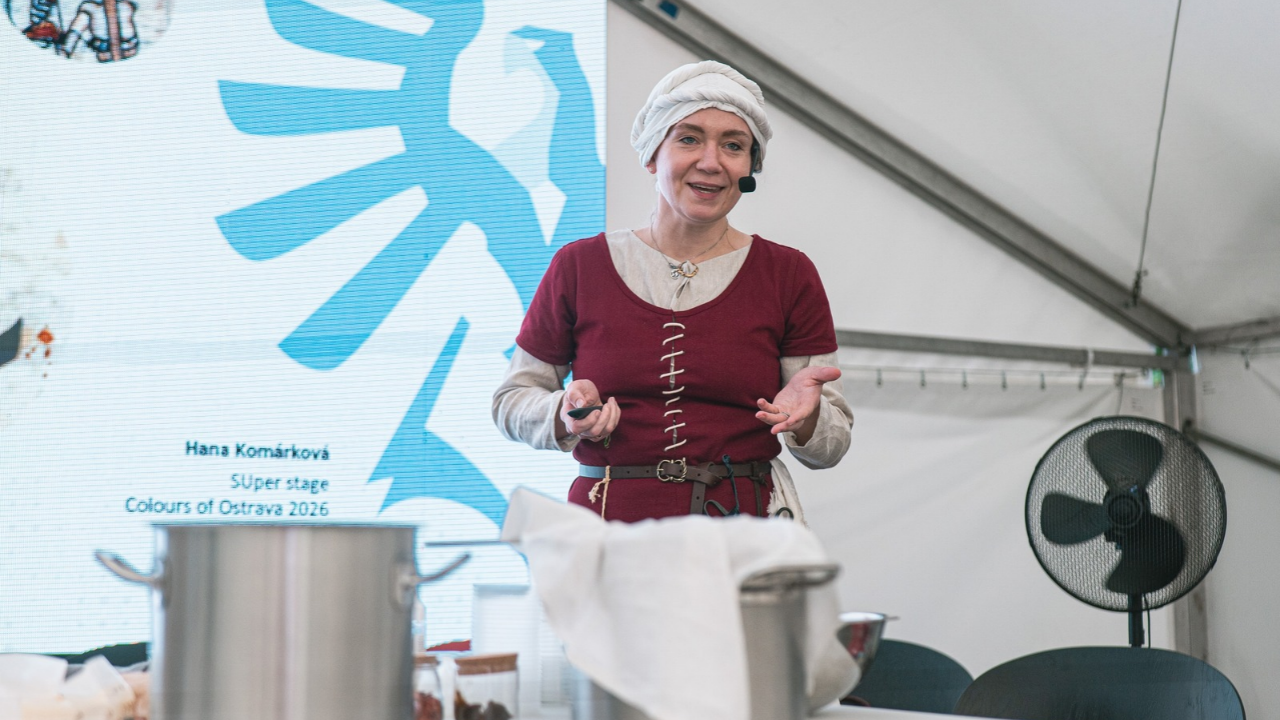
She also shares her research with the public. She gives talks on clothing, perceptions of time and accounts of natural disasters in medieval chronicles, and organises workshops on making medieval remedies and cosmetics. Her public engagement extends to festivals, including Colours of Ostrava. Alongside specific topics from the past, she introduces audiences to the work of historians and the methods they use to examine and interpret surviving accounts.
Outside her professional life, she enjoys detective series from the 1970s, 1980s and 1990s, particularly Murder, She Wrote. In the university newsletter, she humorously admitted that she could explain this interest as a way of exploring the norms and values of the period. Her own description, however, is more straightforward: “The truth is that I generally have a weakness for lowbrow television.” As evidence, she added that she once watched every episode of the Czech series Žena za pultem in a single sitting.
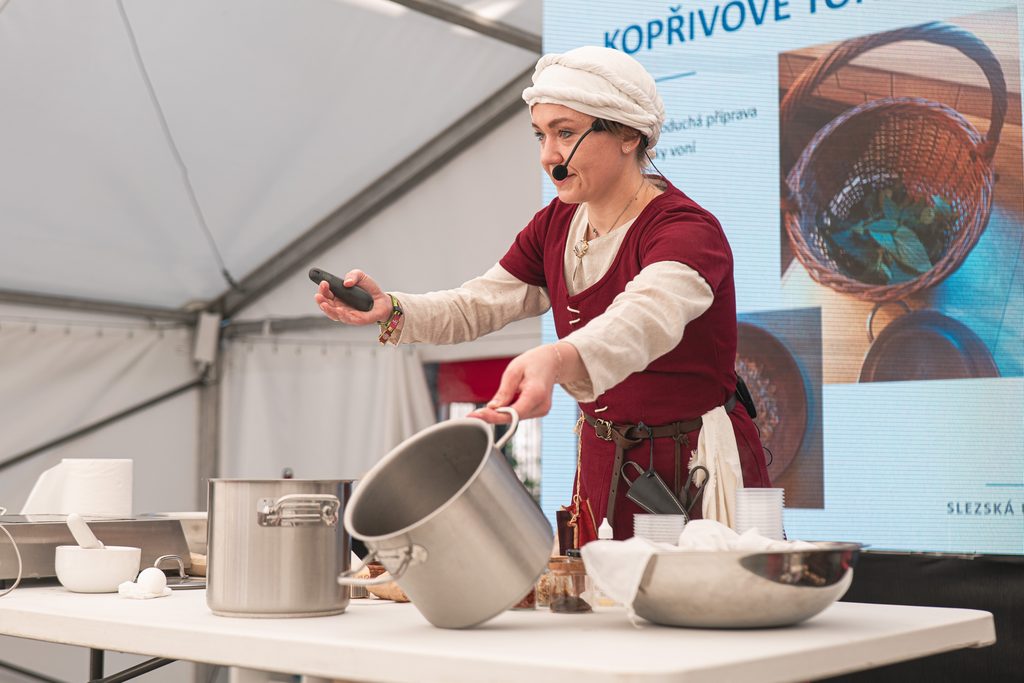
Mgr. Hana Komárková, Ph.D., leading a workshop and lecture titled “Beauty (Doesn’t) Have to Hurt” at the Colours of Ostrava festival.