What happens to matter near a black hole? And what can its surroundings tell us about how the universe works?
Professor Zdeněk Stuchlík has devoted much of his scientific career to these questions. In Opava, he gradually built a research centre around them, bringing young physicists into collaboration with international teams.
His work on black holes began while he was studying theoretical physics at the Faculty of Mathematics and Physics of Charles University. They were the subject of his master’s thesis, supervised by Professor Jiří Bičák. He went on to specialise in relativistic astrophysics: the study of phenomena in which gravity is so strong that Einstein’s theory of relativity is needed to describe them. His research explores the motion of matter and light around black holes and neutron stars, as well as questions concerning dark matter and dark energy.
Stuchlík’s story is also part of the story of Silesian University’s foundation and growth. In the early 1990s, he helped establish the university, served as the first dean of the faculty in Opava and held positions in the university’s leadership. For many years, he headed the faculty’s Institute of Physics. In Opava, he developed theoretical astrophysics, established international collaborations and trained successive generations of scientists. When the Institute of Physics became a separate university unit in 2020, he became its director, leading it until 2026.
His team’s research extends beyond equations. Theoretical models help interpret observations of processes around black holes and other compact objects. The Opava institute has also contributed to preparations for international space projects focused on high-energy radiation from the universe. His scientific and teaching work has earned him distinctions including the 2016 Kopal Lecture Award and the 2019 František Nušl Prize, the Czech Astronomical Society’s highest honour.
Alongside physics, fine art photography has an established place in his life. He photographs landscapes, architecture and seemingly ordinary places, using light, movement and long exposures to transform them into distinctive images. His work has been exhibited in the Czech Republic and abroad. The professor who studies space and time through physical models also works with them through the lens of a camera.
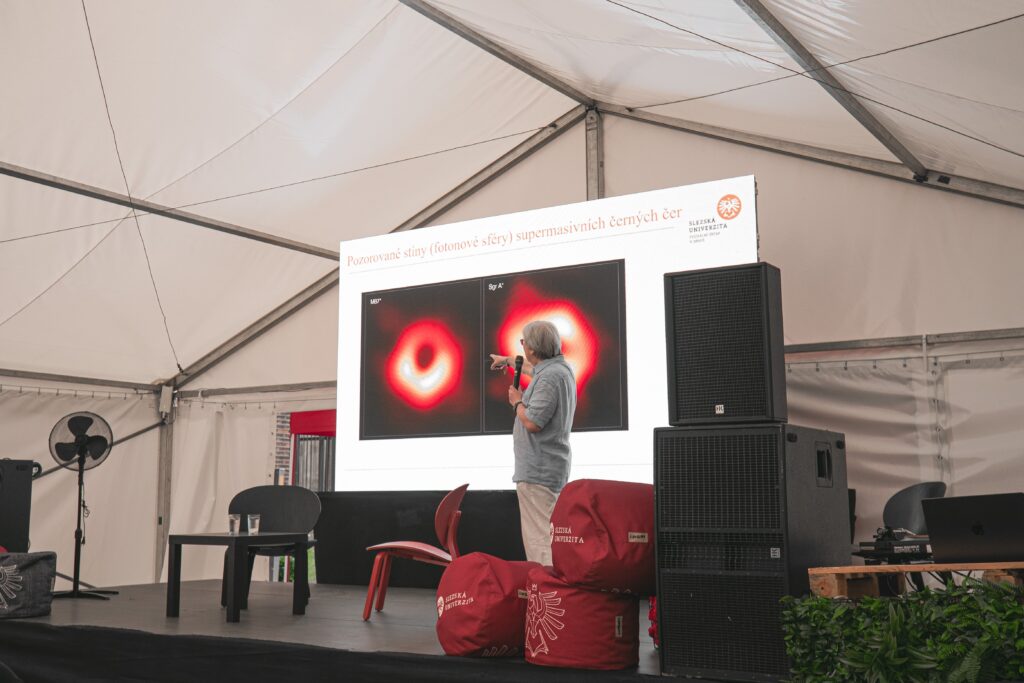
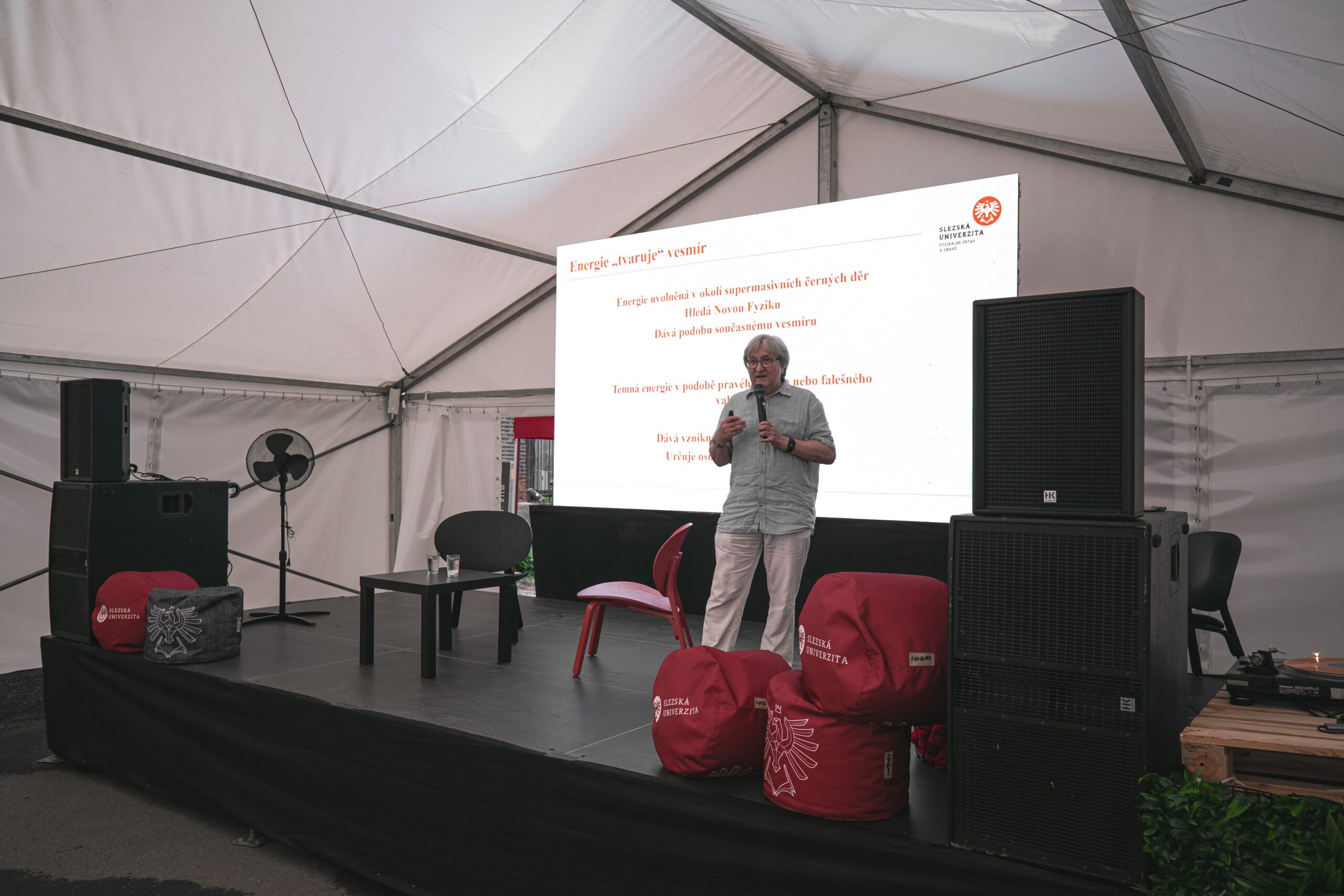
prof. RNDr. Zdeněk Stuchlík, CSc., lecture at the Colours of Ostrava festival.